
The Illusion of Scaling by Headcount (Why Startups Must Be Agentic)
Published on
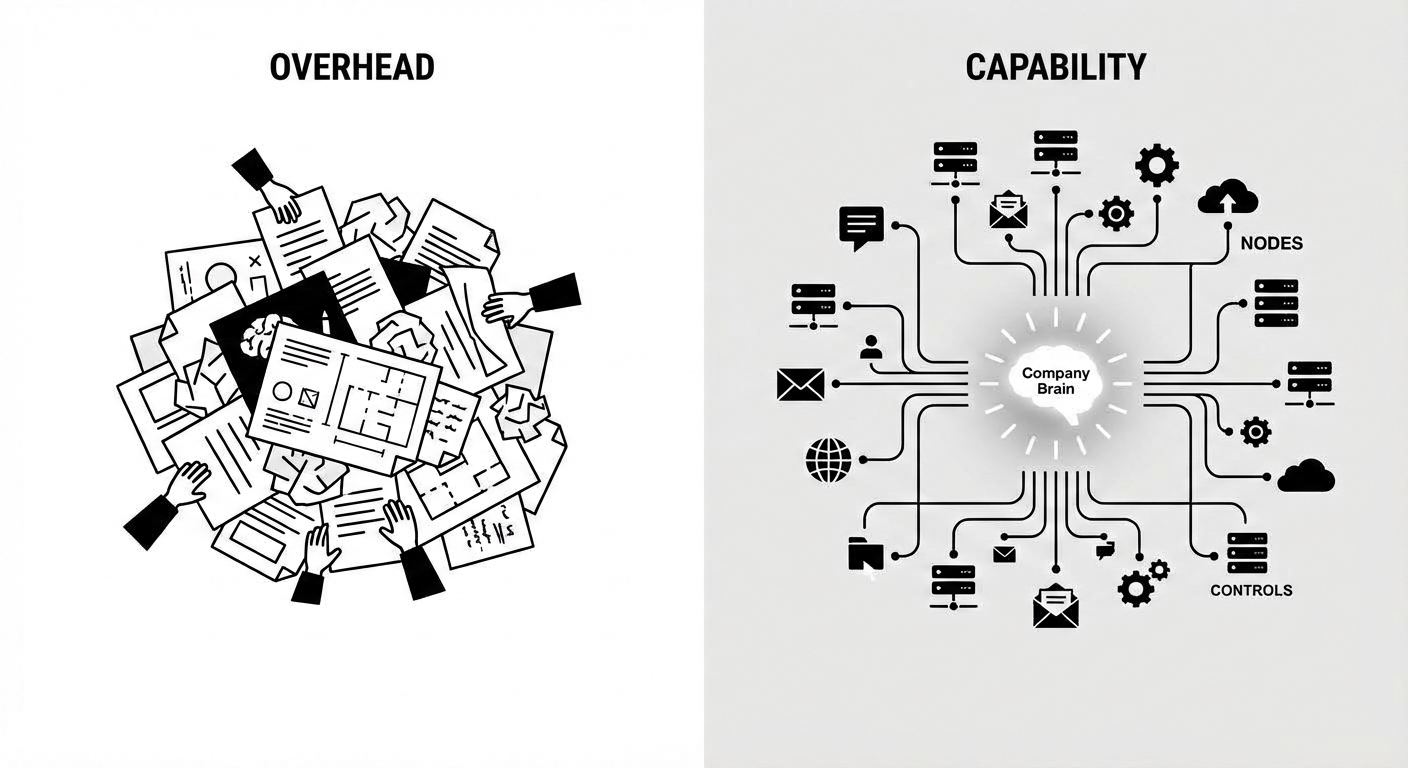
Have been thinking about a new landscape for startups. For decades, the answer to “how can we do more and do faster?” has been “hire more engineers” or “optimize ways of working.”
For a startup fighting incumbents, that model is fundamentally broken with agentic AI capabilities.
We should think agentically.
When a startup lands more projects, the instinct is to hire. But traditional human scaling is linear, and its frictions are exponential. With every new engineer, communication overhead multiplies. The founding team’s core design philosophy dilutes. Institutional memory fractures into tribal knowledge stored in Slack threads and personal hard drives. You aren’t scaling your firm’s intellect; you are just renting more hands.
But agentic AI is maturing rapidly, and it has reached an inflection point that changes how companies are built from day one. We are moving beyond basic chat interfaces into autonomous systems: coding agents like Claude Code executing complex repository tasks, workflow agents like n8n automating operations, and orchestration frameworks like LangGraph and Google Vertex Agents connecting disparate systems together autonomously.
What if your startup itself possessed the intellect?
What if every project, every simulation, and every failure was immediately ingested into a central nervous system? This is the dawn of the Agentic Firm. Consider the code editor Cursor. In early 2025, they hit a staggering $100 million in Annual Recurring Revenue. Their team size? Just 12 people. They didn’t scale by renting hundreds of hands; they scaled by building unified intelligence.
We’ve reached the point where the highest leverage a startup can have isn’t hiring 50 more executors to do routine CAD work or write boilerplate code. It’s building a unified “Company Brain” that a tiny team of visionary founders can command.
What I can foresee in the near future is: more companies, smaller in size, and greater in achievements.